Wargaming terrain serves 2 purposes; It will set the scene for your period and scenaria and act as cover for your troopers. This cover can be buildings, bunkers, strongpoints, sandbag positions, foxholes, (abounded) vehicles, bombshell craters, hills, rocks, trees, woods, vegetation and general "clutter". Anything that can give them some needed protective covering and concealment during the battle. If you're gaming outside, its pretty easy to give them both concealment and protective cover, as the nature will take care of that just like the real thing. I live in Norway and playing gaming outside is not an all year activity, so I prefer to be inside.
 |
Outside you can easily add cover, and the scenery looks good.
|
Tabletop gaming
As many of you using your soldiers for wargaming inside already may be familiar with, is that 'Tabletop (war-) gaming' is ,by it's nature, pretty flat. It's limited how hilly scenery that can be created on a tabletop, and easily stored away when not in use. To add some interest and challenges to the otherwise flat tabletop, some kind of covering to prevent being seen or hit by enemy fire is most useful and needed. Suitable covering can be improvised and made by easily, cheap and accessible things that you have to hand, and can be virtually anything. Or you can use items more adapted for your army men.

|
These photos were taken during my very first wargame as I wanted to try it out. I used unpainted plastic soldiers and things I could easily find at home; my kids' obsolete Moomin playhouse, books for hills, a folded ruler for a wall, cut down toilet-dowels for foxholes and coffee capsules for low vegetation. The game was good fun though, and I decided to paint my soldiers for a start. Then it's just escalated...
 | Even in the "toybox" useful items for wargaming can be found and customized. I've described how I repainted those two vehicles in the front in an earlier post, and det Beetle in the back needs som heavy weathering and will act as cover. The bushes are form an old farm set.
|
|
Playsets
If you buy your army men in cheap 'playsets' in boxes or buckets, you usually get some 'scenery-items' such as bunkers, trees, sandbag positions, fences and Czech hedgehog along. They are not 'finescale' and they are often hollow with molded details on only one side. If you paint them, they can look pretty good.
 |
| The fences, sandbags, ruin and the Czech hedgehogs were obtained from the two playsets in the background and painted. |
 |
When I tested my own "homebrew" rules (Once upon a dice in the West), I covered the table and books with a suitable sand colored cloth. The fences, cactuses, trees and a wagon were from old playsets. The building and well is from my old 'toybox' and were made in Western Germany by Vero back in the 70ies. The figures are Britains Deetail and are from my old toybox as well.
|
Some Playsets or scenery items are available from more established plastic soldiers manufactures like for instance Airfix, but are usually a little more expensive and harder to get. The availability is nothing like it was back in the 'good old days' unfortunately.
 |
Two buildings fromAirfix' 1:32 scale range. They've been around since my childhood and I'm found of them even if they have very thin walls for such buildings in such a scale. I'll let them giver my troopers a cover-save.
|
Plastic kit manufactures
If you are into 54mm or 1:32 scale plastic soldiers, you can find a lot of useful accessories and kits from different main 1:35 scale manufacturers like for instance Italeri and Tamyia. Being kits they are usually more expensive, but you can be lucky to find them really cheap on close-out sales, at sale-stands at exhibitions or simply secondhand from fleamarkets etc.
I know of one exception to this, and that is
Amera Plastic Mouldings who makes some cheap scenery items in 1:32 or 1:35 scale in vac-u-formed plastic. I haven't tried them out (yet).
 |
All these kits are 1:35 accessories from Italeri. Kits are usually more fragile and expensive than the other options in this post, but these I found very cheap at a second-hand market. I've not come around to repaint that shed in the midle back yet, and I also plan to build that well soon.
|
DIY
There are a lot of resources on the internet that shows you how to turn cheap and available items into good looking scenery-items for your wargaming and plastic soldiers. On Youtube there are some online 'clinics' showing you how to do it as well, and one om my favorites is Mel
'The Terrain Tutor'.
 |
The rock-formations are made by cut and painted blue styrofoam pieces, and glued to old CD-discs I'm done watching. The light and moss are Christmas-decorations from the craftshop modified to suit my purpose. The burnout marker I built from a description from The Terrainturor on Youtube:
|
DIY with paper
On the internet you can usually find a lot of free and downloadable paper kits which you can just print to get useful scenery-items for your tabletop gaming. For their games intentionally,
Combat Storm used to have a couple of buildings, some walls, sandbag positions, cars and containers free to download from their page. Another suitable free of charge printable models in 1:35 scale and just about right for
"Armymen-scale" are the easy to build military vehicles from
Dave's Card Creations. I especially like the M113 APCs and HUMMVs. And
here you should be able to find several free building kits. One advantage with these is that they can be resized to your needs before you print them.
DIY in plastic
Due to other
needs in our family, my family bought a
'cheap' 3D-printer. When not in use for it intentional purpose, I got curious if it was usable for my hobbies being wargaming with toy soldiers, model railroading or RC-hobby as well. After a visit on
Thingeverse, a website with thousands of files of models you can print for free for your own use, I was not in doubt anymore; There are a lot of different useful (everyday) gadgets there, but also literally thousands of files that can be printed into 'scale models' as well. You are not limited to print just scenery items as I've done in this post, as vehicles, figures, gaming miniatures, tokens, markers, dice-towers and even
"hill-kits" are available on Thingeverse as well. I decided to take on my wargaming as I wanted more covering items and scenery for my otherwise flat tabletop.
 |
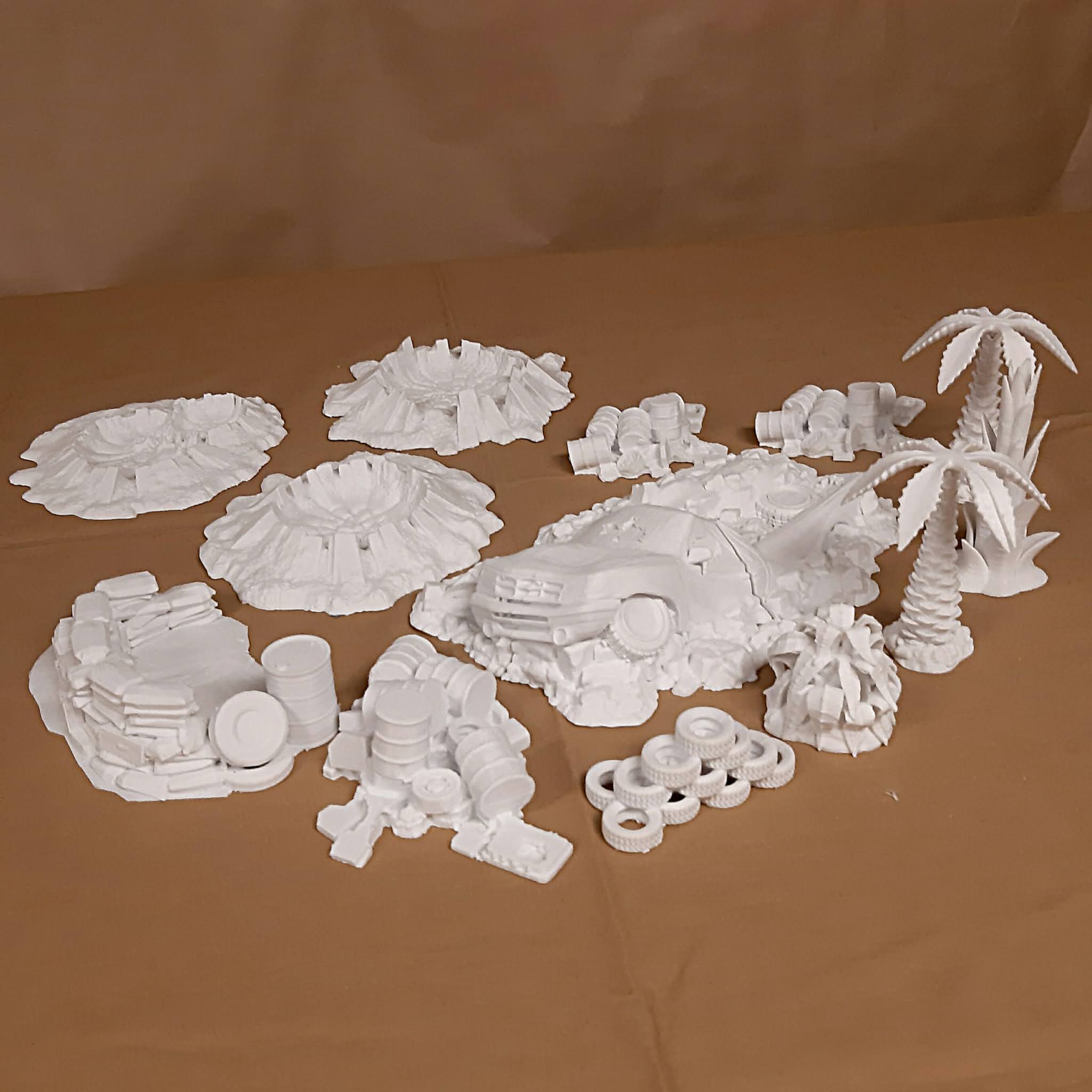
Here is a selection of what I've been printing so far. I'm not completely done yet for my 54mm wargaming, and have a model printing while I'm writing this.
|
There are actually not a lot of files scaled specific to 1:32, 1:35 or 54mm on Thingeverse. I discovered that many files/models for tabletop gaming was scaled to 1:56/28mm, 15mm or not to a specific scale at all. Since I wanted to use this to get my 54mm soldiers reviewed earlier in this blog, items they could take cover behind during 'combat', I simply edited and scaled the 28mm and 15mm files/models I wanted up to 1:35 scale. A 28mm model scaled to 160% is about 1:35. The reason for this is that our printer has a limited print-bed to 14x14x14 cm, and my 'Matcbox clones' are probably closer to 1:35 than true 54mm scale anyway. Besides, when you scale up models you use a lot more filament/plastic when you print them. Printing to 1:35 instead of 1:32 saves a little plastic, and is notable when you print many models. This is another advantage with printing your own terrain and scenery; You only print what you need, as you don't have to buy a whole 'set' to just get some of the parts in it. In the long run this will save you for both money and space taken up by items you really didn't need.
Large models usually comes in several files, and you have to print them separately and assemble them as a kit at the end. What to do when you need larger parts than the printbed on your 3D-printer can accommodate? As you can edit and scale files and models up and down, you can also edit it by cutting it up in pieces and print them separately and joint them together afterwards.
 |
The models on the top row are multiple files printed separately and joined in the end. The wreck on the bottom row was to large for my printer when I scaled it up to about 1:35 scale, so I just "cut" the file in 4 and printed them separately. It was very easy.
|
So what does it costs? When we bought our printer it costed about $ 498, £ 385 or EUR 422. Now days you can get them even cheaper if you wants to assemble it like a kit yourself. Another thing you'll need is filament, the plastic you need for printing. We use a PLA-filler which is non-toxic or with no (harmfull) fumes. One roll of about 200m of PLA-filament costs about $ 20, £ 15 or EUR17 here. How many models you can get out of each roll of filament is depending on scale and size on the models you want to print. These models in approx 1:35 scale are printed from the same roll of filament:
 |
And it's still some filament on the roll, I can use for smaller models.
|
On the downside it takes some time to get your models. Much longer time than go to the store and buy one. First you have to use time finding the models you want to print and then further time editing (converting the file in a slicer) the file before printing. Printing takes (a lot of) time, and it's more time consuming to print larger models than smaller models. And it takes even longer time if you print in thin layers. Now I seriously consider to start wargaming i 1:72 scale, as it will save time and plastic, and give more models for each roll of filament.
 |
Patience is needed! The barrels to the left took 7 hours and 5 minutes to print. The L-shaped sandbag position down at the right, just over 5 hours, and the 1. floor of a larger building to the top right about 12 hours and 13 minutes (!) Due to the heat involved you can't just leave it over night or do it while at work...
|
I know some are skeptic to 3D-printed models due to the printing layers, as can be seen as small lines in the model. -Especially on slopes. Thicker the layers, the more visible they become. Despite this, many printed models have good details and looks realistic, and I think they will look even better when painted. And unlike some playsets items, They have 'depth', thickness and details on all sides. You can print smaller and sharper objects and details if you buy a even more expensive 3D-resin printer with even more expensive filament, but that's not for me. I hope to find a easy way as I think it's too time-consuming to sand them smooth afterwards. Perhaps priming with car body filler on rattle-can will work?
You can still get 3D-prints even if you don't have a 3D-printer. If You don't have a friend with a 3D-printer and a lot of time, who'll let you use his or her printer, you can buy ready 3D-printed models from
Shapeways. Often you can get them resized to your need as well, but do check the price first! Mostly if reasonable priced, but a few times I've found some models on Shapeways which I've also found for free on Thingeverse, but the difference is that on Shapeways it costs about the same as 4 full rolls of filament (!). Perhaps their print quality justifies such a price?
Time to finally do som painting
Finally I got around to do some painting. So what to paint my newly scenery items like, and where and when should they represent???
Generic approach
Despite I'm quite new to tabletop gaming, there are a lot of different eras, conflicts, scales and games (both historical and sci-fi) I would like to play. I don't have unlimited space at home for all my modelling hobbies, so I can't just go ahead and make scenery items for every game, battle or period I'd like. So I've decided to make and paint scenery items so generic that I can combine and use them for as many different games, settings, eras, scales and conflicts as possible.
Since I've already got 54mm miniatures for gaming in the old west, Sci-fi, and for post WWII conflicts in Africa and the Middle East, it was clear that I had to go for some kind of scenery they all have in common. Besides, the Middle East might be a suitable 'theater' for future wargaming projects as well, since it's the most war thorn region of the world through the whole history.
I decided to go for a desert-like, sandy, dusty wasteland scenery, as it will be suitable for different eras and conflicts in the Middle East and Africa, as well in the southern parts of the 'Old West' or in a Sci-fi setting on a Mars-like or 'Tatooine' planet.

The painting it self was straight forward; Solid layers of tan color(s), washed with dark brown, and drybrushed with 'Titanium Buff'. All painted with cheap craft acrylics.
By just adding some craters to the rocks make you have a Middle East/African battlefield or a Sci-fi setting:
For vegetation I selected plants and trees I don't think would look out of place in a sandy and dry habitat:
This was 3D-printet in black PLA and simply drybrushed with various 'browns', starting dark followed by lighter shades:
Adobe style buildings can be found in The MiddleEast, Africa and in southern parts of Northern America:
With generic scenery further period and location can be set by adding periodic or geographical items. Here is some detail to set the scene to Middle East or African wargames:
When 3D-printing you sometimes add 'Rafts'to your print to make your model stick better to the printbed. When done printing you separate them and usually throw the raft away. I found some of the rafts from my previous 3D-prints to be so sturdy and of irregular shape that I would try to use them as terrain bases. The greenery is just lichen for Christmas decorations found in craft stores. Thanks to Rick Astley for providing one of those circular bases in the middle. I knew he was never giving me up...
Circular CD-bases again. I think this is one of the Mrs' 'Game of Thrones' seasons...The rocks are made by cutting blue and pink extruded foam to shape and painted.
This is made by adding pieces from 'The Force' and 'The Corps' playsets to a raft for 3D prints. A CD or any other suitable base will work as well
Even stationary vehicles can act as periodic gaming terrain, and add some cover for your troops. The toy car was to correct scale, but looked a little too pristine at first...
The 'battle mat' is made by a tan piece of inexpensive cloth simply stippled with different browns and greens acrylics by a coarse sponge. Roads, rivers and lakes are just fabric in a different colors, and are loose to change the scenery for different scenarioes
There are still a lot of interesting and available free 3D-files ready to download and print out there, but in this scale I'll just have to limit myself as I already have challenges with storing it properly. Besides I should have enough scenery and terrain by now to make up interesting games. Now it's about time to let the (war-) Game(s) begin, so please follow the blog for updates!
For more and faster updates on my miliary modelling hobbies like Military Garden Railways, Wargaming, Model Railways and Military modelling in general please visit my main blog:




 Even stationary vehicles can act as periodic gaming terrain, and add some cover for your troops. The toy car was to correct scale, but looked a little too pristine at first...

Comments
Post a Comment